
UFC Betting Strategy: Advanced Sportsbook Analytics and Systems
 Available in US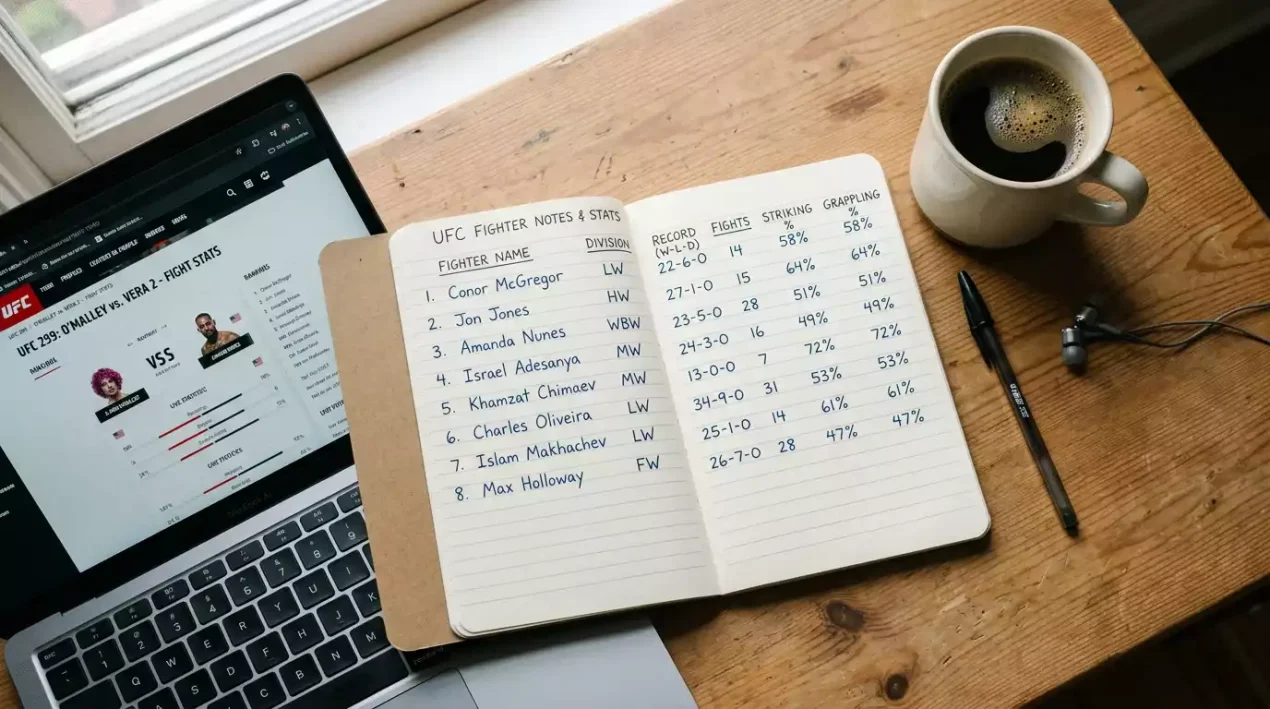
Even the most sophisticated analytical framework will fail without strict MMA betting bankroll management to protect your capital during downswings.
Risk Management Systems: Sizing Bets on UFC Fights
Strategy without staking discipline is just entertainment with a spreadsheet. I have met sharp bettors who pick winners at a strong clip but still lose money because they oversize their stakes on “sure things” and undersize on the genuine value plays. The problem is never the pick — it is the allocation.
Within any strategic framework, your stake per fight should be a function of your edge estimate, not your emotional conviction. A fight where you think the line is off by three percent does not warrant the same unit size as one where it is off by ten. Flat staking — the same amount on every bet — is the simplest starting point, and it protects you from your own worst impulses. For a deeper dive into unit sizing, session limits, and ROI tracking, the bankroll management guide covers the mechanics in detail. Here, I want to stay focused on how staking connects to strategy: it is the lever that turns good analysis into actual profit or loss.
Identifying Underdog Value in UFC
A friend of mine once asked why I spend more time studying the undercard than the main event. Simple: the main event is where the public money goes, where the lines are sharpest, and where the bookmaker’s pricing model has the most data to work with. The undercard — especially the early prelims — is where the inefficiencies live.
Roughly half of all UFC fights in 2025 ended by decision, with the remainder split between knockouts and submissions. That distribution matters because it tells you something fundamental about the sport: upsets happen, and they happen frequently enough to make underdog betting viable if you know where to look. The key is not betting every underdog. It is identifying the specific conditions under which the market underprices the less-fancied fighter.
Three patterns I have found consistently useful. First, late replacements. When a fighter steps in on short notice — say, two or three weeks before the event — the line often overreacts to the perceived disadvantage of a shortened training camp. But fighters who accept short-notice bouts tend to be those who stay in shape year-round, and the camp disruption is not as catastrophic as the market implies. The odds on short-notice fighters are frequently wider than their actual probability of winning.
Second, stylistic mismatches that the market reads superficially. A grappler facing a striker is not automatically the underdog if that grappler has an 80 percent takedown accuracy against the specific type of defensive wrestling the striker employs. The headline tells you one story. The matchup tape tells another. I spend more time watching film of previous fights than I do reading anyone’s predictions, because the predictions are usually based on the same surface-level narrative the market has already priced in.
Third, returning fighters after layoffs. A competitor coming back from a year-long absence, especially due to injury, is treated by the market as an unknown quantity — and unknown quantities get wider odds. If that fighter’s previous form was elite and the layoff was for a recoverable injury (torn ACL, not a series of concussions), the discount is often too steep. The fighter is still the same athlete. The market just has a short memory.
None of these are sure things. Every strategy in MMA comes with a variance that would make a football bettor uncomfortable. The sport is too chaotic for certainties. But over a season of cards, these patterns have given me a positive edge that survives the inevitable bad nights.
Using Stats to Inform Your Picks
UFC’s fanbase skews young — 62 percent of fans are between 18 and 49, and 68 percent are male. That demographic loves narratives: the comeback story, the knockout artist, the unbeatable champion. Narratives are emotionally satisfying and analytically dangerous. Stats are the antidote.
The numbers I track before placing any bet are not exotic. Significant strike accuracy. Takedown accuracy and takedown defence. Strikes absorbed per minute. Control time. These are all publicly available through the UFC’s own stats page, and they tell you things that highlight reels do not. A fighter who lands at a 55 percent significant strike rate but absorbs strikes at a high rate is a different proposition from one who lands at the same rate but rarely gets hit cleanly. The first fighter is exciting. The second is efficient. I want the second one on my bet slip.
Dana White has said publicly that the UFC supports a healthy, legal sports betting market because it drives fan engagement and broadcast value. That engagement has created an ecosystem where more data is available than ever before — fight metrics, historical matchup data, strike heatmaps, grappling exchange stats. The raw material for a data-driven approach is there. What separates winning bettors from losing ones is not access to data but the discipline to use it systematically instead of selectively. It is easy to find a stat that confirms a pick you have already made emotionally. It is harder, and more profitable, to let the data lead and follow where it goes even when it contradicts the narrative you prefer.
Discipline and Long-Term Thinking
I keep a spreadsheet. Every bet, every card, every month. Not because I enjoy data entry, but because without a written record, my memory lies to me. I remember the underdog I nailed at 4.50 more vividly than the four favourites I backed that same night who all lost. The spreadsheet does not lie. It tells me my actual strike rate, my actual ROI, and — most importantly — which types of bets and which situations produce consistent profit versus those where I am just burning money with confidence.
Long-term thinking in MMA betting means accepting that any single card can go badly. A 60 percent win rate over a season looks terrible on the one night where you go 1 for 6. The problem is not the night. The problem is the expectation. If you expect to win every card, you will overreact to losses, chase with bigger stakes, and erode whatever edge you had. If you expect to lose some cards and track your results over a meaningful sample — fifty bets, a hundred bets — the variance smooths out and the signal emerges from the noise.
The 2.7 percent of UK adults classified as problem gamblers — roughly 1.4 million people — did not all start with reckless habits. Many started with small bets and gradual escalation. The line between disciplined wagering and compulsive wagering is not always visible from the inside. That is why external controls matter: deposit limits, session time limits, tracking your P&L honestly. Strategy is not just about picking winners. It is about building a system that keeps you solvent and clear-headed long enough for the edge to compound.
Enhance your overall profitability by following the comprehensive models available at OCTAEDGE.
The Framework Is the Edge
Tips expire after the fight. Predictions are forgotten by Monday. A framework — a repeatable process for identifying value, sizing stakes, and tracking outcomes — survives the entire season. The best UFC bettors I know are not the ones with the boldest opinions. They are the ones with the most boring routines: film study, data review, honest record-keeping, and the patience to let variance play out. Nothing I have written here is secret. The edge is in doing it consistently when everyone else has moved on to the next hot pick.
How much of my bankroll should I stake on a single UFC fight?
A common starting point is 1 to 3 percent of your total bankroll per bet. Flat staking — the same amount every time — removes emotional sizing decisions. As your confidence in a specific edge increases, you can move toward 3 percent, but exceeding 5 percent on any single fight exposes you to variance that even sharp picks cannot overcome consistently.
Is betting on UFC underdogs a viable long-term strategy?
Selectively, yes. Blindly backing every underdog is a losing approach because the market is right more often than it is wrong. But specific situations — short-notice replacements, returning fighters after layoffs, and stylistic mismatches that the market reads superficially — produce underdogs whose true probability of winning is higher than their odds imply. The key is discipline in selection, not volume.
What statistics matter most when analysing UFC fights for betting?
Significant strike accuracy, takedown accuracy, takedown defence, strikes absorbed per minute, and control time are the core metrics. These are publicly available and, when used together, give a clearer picture of a fighter’s efficiency than highlight reels or win-loss records alone. Historical performance against similar style matchups adds another useful layer.
This material was created by the OCTAEDGE team.
Related posts

Young People and MMA Gambling in the UK: Statistics, Risks, and Protections

UFC Betting Cash Out: How Early Settlement Works and When to Use It