
UFC Round Betting: Over/Under Markets and Settlement Rules
 Available in US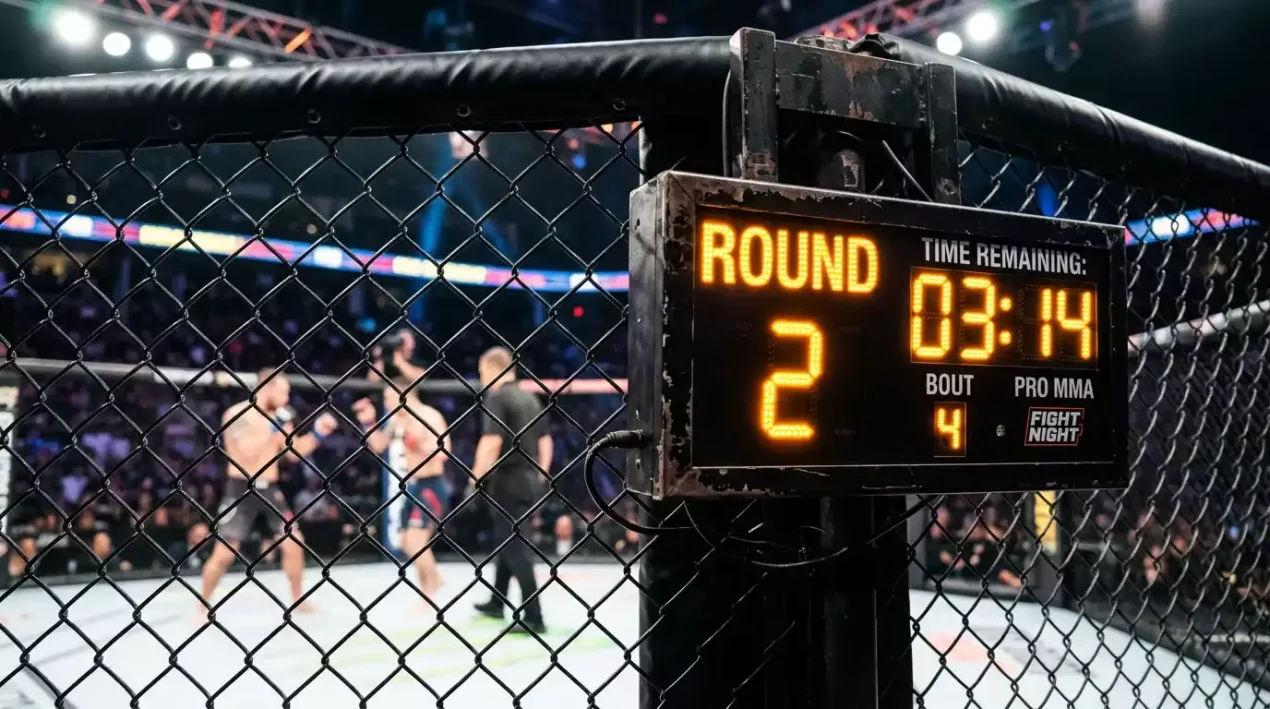
Approximately half of UFC bouts in 2025 ended by decision, which means the other half produced finishes that settled round-betting markets. Those finishes did not distribute evenly across rounds, and understanding where they cluster — and why — is the foundation of every round bet worth making.
Sportsbook Settlement Rules: How the UFC Half-Round Line Operates
In UFC round betting, the boundary between one round and the next is not the bell. It is the midpoint of the round. A standard UFC round lasts five minutes, and the half-round threshold falls at 2 minutes and 30 seconds. A finish that occurs at 2:29 of round two is settled as a “round two” finish. A finish at 2:31 of round two falls into the second half of that round and, for the purposes of grouped round bets and over/under markets, may be treated as the boundary between “under” and “over” depending on the specific line.
This rule exists because a five-minute round needs a defined midpoint for over/under markets to function. Without it, a fight that ends at 2:30 of a round would be ambiguous. With it, every possible fight ending maps to one side of the line. The rule is consistent across all major UK bookmakers for UFC events, though the exact wording can vary — some operators phrase it as “2:30 of the round,” others as “the midway point.” The settlement outcome is the same.
The practical consequence is that round-betting markets are more granular than most bettors realise. “Fighter A to win in round one” means a finish between 0:00 and 4:59 of the first round. “Over 1.5 rounds” means the fight must reach the 2:30 mark of round two. If you are used to football or tennis betting where the outcome boundaries are obvious, MMA round betting requires you to think in terms of time within rounds, not just rounds themselves.
Three-Round vs Five-Round Fight Dynamics
Standard UFC bouts are three rounds of five minutes each. Main events and title fights are five rounds of five minutes each. That difference has a direct impact on round-betting markets because it changes both the total number of possible outcomes and the tactical approach fighters take.
In three-round fights, the urgency starts early. Fighters who are behind on the scorecards after two rounds know they have one round to change the outcome, which leads to more aggressive third rounds and a higher concentration of late finishes. The over/under line is typically set at 1.5 or 2.5 rounds, and the distribution of finishes tends to cluster in rounds one and three — early ambushes and late desperation — with round two producing the fewest stoppages.
Five-round fights follow a different pattern. The additional time allows fighters to be more patient in the early rounds, conserving energy for a longer contest. Finishes in five-round fights are spread more evenly, though round four often sees an uptick as fatigue accumulates and defensive lapses increase. The championship rounds — four and five — are where cardio differences become decisive, and a fighter who is visibly tiring in round three of a five-rounder is a strong candidate for a late finish against them.
For betting purposes, this means the same two fighters can produce different round-betting dynamics depending on whether the bout is scheduled for three or five rounds. A fighter who typically coasts through three rounds and wins by decision may push harder in a five-rounder because the additional rounds reward pace and pressure. Checking whether a fight is three or five rounds before pricing any round bet is not a detail — it is a prerequisite.
Grouped Round Bets and Over/Under Rounds
Not every bookmaker offers exact-round finish markets for every fight. When they do, the odds are typically long — winning in a specific round is a low-probability event by definition. Grouped round bets aggregate multiple rounds into a single selection: “Fighter A to win in rounds 1-2” or “fight to end in rounds 3-5.” These markets offer shorter odds than exact-round picks while still requiring a view on the timing of the finish.
Over/under rounds is the most accessible round-betting market and the one where I find the most consistent value. The line is typically set at 1.5 or 2.5 rounds for three-round fights and 2.5 or 3.5 for five-rounders. The global MMA betting handle reached $10.3 billion in 2024, and a meaningful share of that volume flows through round-total markets because they offer a clear binary outcome with relatively low margin.
The pricing on over/under rounds reflects the bookmaker’s estimate of the combined finishing rate of both fighters. When both fighters are heavy finishers with high knockout rates, the under is favoured. When both are defensive technicians with low finishing rates, the over is favoured. The mispricing occurs when the market weighs one fighter’s finishing profile too heavily and underweights the other’s defensive ability. A fighter with a 70 percent finishing rate sounds like an “under” play, but if their opponent has never been finished in fifteen professional fights, the “over” may be the sharper side.
Where the Value Sits in Round Markets
The average bookmaker margin on UFC moneyline markets is approximately 4 percent. On round-betting markets, the margin widens to 8 to 15 percent depending on the granularity of the bet. Exact-round finishes carry the widest margins because each individual outcome has a low probability, and the bookmaker builds in a larger cushion. Over/under rounds markets are tighter, often comparable to the moneyline, making them the most bettor-friendly round market.
I concentrate my round betting on over/under markets for exactly that reason. The margins are manageable, the pricing is influenced by the same public biases that affect moneylines (favouring finishes over decisions, weighting recent results too heavily), and the analysis required is more straightforward than estimating the probability of a finish in a specific 150-second window.
When I do bet on exact rounds or grouped rounds, it is because the stylistic matchup creates a strong timing hypothesis. A pressure wrestler who historically secures takedowns in the first two minutes of round one, facing a striker with poor takedown defense, produces a round-one finish probability that the market often underestimates. The bet is not “this fighter will win in round one” as a lucky guess — it is “this fighter’s path to victory runs through the first five minutes because their primary weapon works best before the opponent adjusts.” That kind of specific, matchup-driven timing read is where round betting transitions from gambling to analysis. For a complementary look at how finish methods are priced alongside timing, the method of victory guide covers KO, submission, and decision markets in detail.
Time Is the Hidden Variable
Most MMA bettors think about who wins. The sharper ones think about how they win. The sharpest think about when. Round betting is the market that rewards the third question, and it punishes anyone who wanders into it without understanding the half-round rule, the three-versus-five dynamic, and the difference between a probability estimate and a hope. The fights are dramatic. The round markets are mathematical. That contrast is exactly where the edge lives.
What is the half-round threshold used for UFC round bets?
The half-round threshold is the midpoint of a standard five-minute UFC round, falling at 2 minutes and 30 seconds. A finish before 2:30 of a given round falls in the first half; a finish after 2:30 falls in the second half. This threshold determines how over/under and grouped round bets are settled. The rule is consistent across major UK bookmakers for UFC events.
Are over/under round totals different for 3-round and 5-round UFC fights?
Yes. Three-round UFC fights typically have an over/under line set at 1.5 or 2.5 rounds, while five-round fights — main events and title bouts — are usually set at 2.5 or 3.5 rounds. The additional rounds in five-round fights change the tactical dynamics: fighters tend to be more patient early, and finishes distribute more evenly across rounds compared to three-round bouts where stoppages cluster in rounds one and three.
This material was created by the OCTAEDGE team.
Related posts

Young People and MMA Gambling in the UK: Statistics, Risks, and Protections

UFC Betting Cash Out: How Early Settlement Works and When to Use It