
UFC Live Stream Betting: Top UK Sportsbooks for Fight Streaming
 Available in US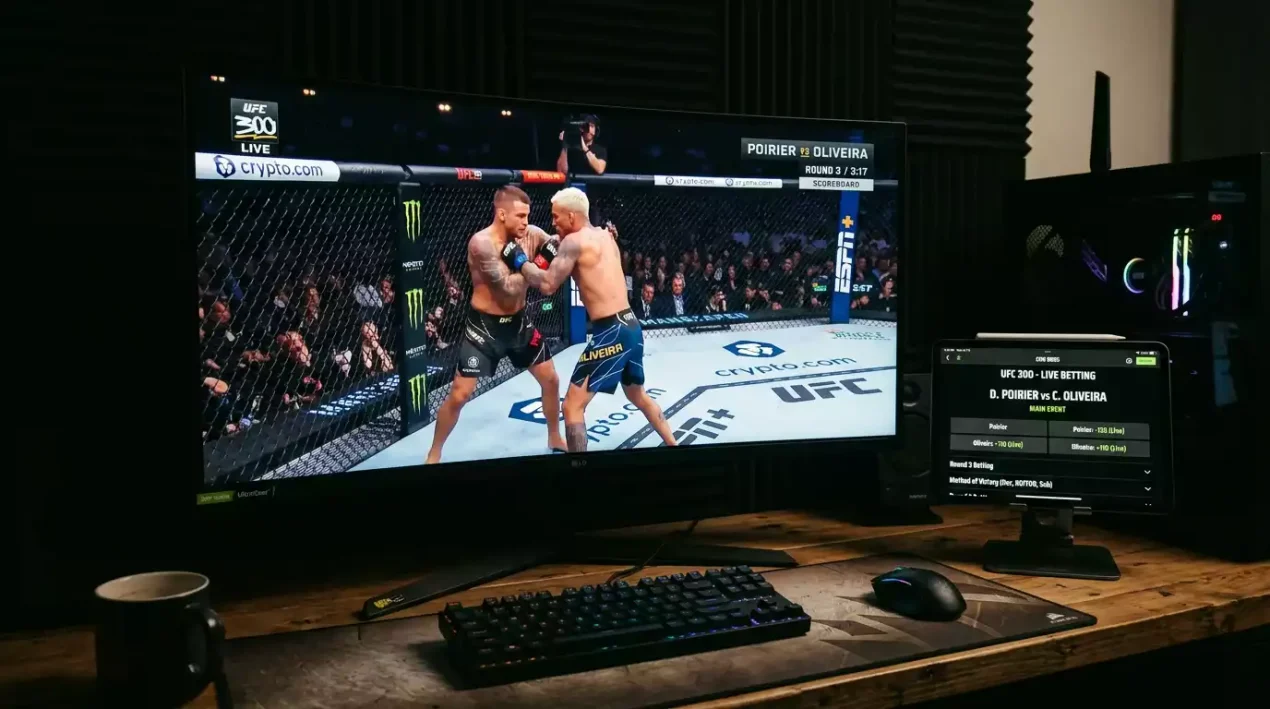
UFC broadcasts reach over 900 million households across 170 countries, and 6.84 percent of all traffic to UFC.com comes from the United Kingdom. The demand from UK fans is real. But accessing a live stream through a bookmaker — and using that stream to inform your bets — involves a different set of considerations than just buying a pay-per-view. This is how the landscape works for UK punters in 2026.
UK Sportsbook Video Broadcasts: Accessing Live UFC Streams
I remember when streaming UFC through a bookmaker meant a grainy, delayed feed that froze every time someone threw a combination. The technology has improved enormously since then, but the coverage model has not changed as much as you might expect. The core issue is rights: UFC broadcast rights in the UK are held by specific media partners, and bookmakers can only stream what their licensing agreements allow.
What this means in practice is a patchwork. Some operators offer full-card streams for events where they hold streaming rights, typically covering the prelims and the main card in their entirety. Others offer selected bouts only — the main event and co-main, perhaps, with no coverage of the early prelims. A third category of operators offers no UFC streaming at all, relying instead on live scorecards and round-by-round text updates.
The UFC’s global fanbase of over 700 million has made it a valuable property for bookmakers seeking to attract and retain customers. Streaming a live UFC event is an acquisition tool: it brings people to the platform and keeps them there for four or five hours. The bookmaker profits not from the stream itself but from the betting activity it generates. That commercial logic means the best streams tend to be on the largest platforms with the deepest pockets for rights acquisition.
Full-Card vs Partial Coverage
Full-card coverage means every fight, from the first early prelim to the main event. Partial coverage means selected bouts, usually the ones the bookmaker expects to generate the most betting volume. The distinction matters more than it might seem, because some of the most valuable live betting opportunities appear on the undercard, where the odds are less efficient and the market is thinner.
If you primarily bet on main-card fights, partial streaming may be sufficient. But if your strategy involves spotting live value on less-publicised bouts — a prospect on the early prelims whose odds shift dramatically after a first-round knockdown — you need full-card access. I have had situations where a prelim fight produced the best live betting opportunity of the entire card, and I only caught it because I was watching from the first bout.
There is also a quality dimension. Full-card streams from operators with strong broadcast infrastructure tend to have lower latency — the delay between real-time action and what appears on your screen. Partial streams, especially those sourced from third-party providers rather than direct broadcast feeds, can run several seconds behind. In a sport where fights end in a single strike, those seconds are not trivial.
How Streaming and In-Play Betting Work Together
The ideal scenario is a single screen where the stream and the bet slip coexist. Several UK bookmakers offer exactly this: a split-view layout on desktop or a picture-in-picture mode on mobile that lets you watch the fight in a small window while browsing live markets below. When it works well, it is the best way to bet on UFC — you see the action, read the odds, and place your bet without switching between apps or tabs.
When it works poorly, the stream lags behind the odds. I have seen situations where the bookmaker’s odds algorithm, fed by data from cageside observers, updated faster than the video stream delivered the same information to my screen. The fighter was already hurt, the odds had already shifted, and the stream showed the punch landing three seconds later. That kind of desynchronisation is rare on premium streams but common enough on lower-quality feeds to be worth watching for.
The synergy between streaming and in-play betting is strongest between rounds. During the sixty-second rest period, you can see both corners, observe the fighter’s physical condition, hear snippets of corner advice if the broadcast picks it up, and make a decision with full visual context. That window is where the stream pays for itself. Without it, you are pricing the next round based on statistics and text commentary. With it, you are pricing based on what you can see with your own eyes — the swelling around the left eye, the way a fighter is favouring their lead leg, the urgency or calmness in the corner’s voice.
For a more detailed look at how live markets behave during fights and when they suspend, the in-play UFC betting guide covers the mechanics of between-round wagering.
Account and Funding Requirements for Access
Nothing in life is free, and bookmaker UFC streams are no exception — though the cost is indirect rather than direct. Most operators do not charge a subscription fee for streaming. Instead, they require you to have a funded account, a placed bet on the event, or both. The specific threshold varies: some ask for a minimum balance of one pound, others require a bet of any size on the card you want to watch.
Since February 2025, UK operators have been required to conduct financial vulnerability checks when a customer’s net deposits reach 150 pounds within a rolling 30-day window. If you are funding an account primarily to access streaming and placing bets to meet the access threshold, you are accumulating net deposits that will eventually trigger those checks. It is not a reason to avoid streaming, but it is worth being aware that the deposits you make to unlock streams are counted alongside every other deposit you make with that operator.
Identity verification is a prerequisite for both streaming and betting. UKGC regulations require operators to verify your age and identity before you can place a bet or access restricted content. The verification process — uploading a photo ID, proof of address, and sometimes a selfie — can take anywhere from a few minutes to a couple of days. If you are setting up a new account specifically to watch a UFC event this Saturday, start the verification process on Monday.
Beyond the Stream: When the Screen Goes Dark
Streaming access is a competitive advantage in live MMA betting, but it is not available for every event, on every platform, at every moment. Cards held in certain territories, co-promoted events with non-UFC organisations, and bouts with broadcast exclusivity agreements may not appear on any bookmaker stream. When that happens, you fall back to live scoring data, text commentary, and the odds movement itself as a proxy for what is happening in the cage. Knowing how to read odds shifts without a visual feed is a skill worth developing alongside the more comfortable experience of watching and wagering in real time. The stream is a tool. It is not the whole toolkit.
Do I need a funded account to watch UFC streams at UK bookmakers?
Most UK bookmakers require either a funded account or an active bet on the event to access their UFC streams. The specific threshold varies by operator — some require a minimum account balance of one pound, while others ask for a placed bet of any amount on the card. No major UK bookmaker currently offers UFC streaming without any account requirement.
Which UK bookmakers stream full UFC cards vs selected fights?
Coverage varies significantly. Some large operators stream entire UFC cards from early prelims through the main event, while others only cover the main card or selected headline bouts. The availability depends on individual broadcast licensing agreements, which can change between events. Check your bookmaker’s streaming schedule for the specific card you want to watch rather than assuming consistent coverage.
This material was created by the OCTAEDGE team.
Related posts

Young People and MMA Gambling in the UK: Statistics, Risks, and Protections
UFC Betting Cash Out: How Early Settlement Works and When to Use It