
UFC Betting UK: Best Fight Odds and Licensed Bookmakers
 Available in US
This guide assumes you know what MMA is and you understand the basics of how fights work. What it does not assume is any prior betting experience. I will take you from legal groundwork through account setup, first odds reading, and an actual worked example of placing a wager, then cover the mistakes I wish someone had warned me about six years ago.
To fully grasp the potential payouts and options available, beginners should familiarize themselves with all UFC betting markets before placing their first wager.
UKGC Licensed Bookmakers: Safe UFC Betting and Regulations
Before you deposit a single pound, you need to understand what sits underneath the entire UK betting ecosystem. It is not just legal to bet on MMA in the United Kingdom — it is one of the most tightly regulated betting markets in the world, and that regulation exists to protect you.
The framework rests on the Gambling Act 2005, updated through successive reforms, most recently the sweeping changes that took effect in 2025. Every operator offering betting services to UK residents must hold a licence from the UK Gambling Commission. That licence imposes obligations: segregated customer funds, access to dispute resolution, mandatory responsible gambling tools, and compliance with advertising standards. Clifford Chance, in their analysis of the 2025 reforms, described them as positioning the UK as “a global leader in responsible gambling regulation” — and that assessment tracks with what I have seen from the inside.
What does this mean practically? It means that when you bet with a UKGC-licensed operator, there is a regulatory body you can complain to if something goes wrong. Your deposits are ring-fenced. The operator must verify your identity and, under newer rules, may run financial vulnerability checks if your net deposits exceed certain thresholds. These protections evaporate entirely if you bet with an unlicensed offshore site.
A quick habit to build: before you register anywhere, scroll to the footer of the site. Look for a UKGC licence number. If it is not there, close the tab. There are more than enough licensed options in the UK market that you never need to compromise on this. With 5,825 licensed betting premises recorded in the latest industry count and a growing number of online operators, the regulated market offers far more choice than any single bettor needs.
Opening a Betting Account in the UK
I timed myself opening a new account at a UKGC-licensed site last month. From landing page to verified, funded account: fourteen minutes. Most of that was waiting for the identity check to clear. The process itself is straightforward, but it has a few stages that catch people off guard if they are not expecting them.
Registration asks for the basics — name, date of birth, address, email, mobile number. You will set a username and password, and most sites will ask you to choose your preferred odds format (decimal is the default I recommend for MMA, but you can change it later). Some operators also ask you to set deposit limits during registration, which is a responsible gambling feature built into the sign-up flow.
Identity verification comes next. Under Know Your Customer rules, the operator must confirm you are who you say you are and that you are at least eighteen years old. Typically this means uploading a photo of your passport or driving licence. Some sites use automated verification services that pull from public records and complete the check in minutes. Others require manual review, which can take a few hours.
Then there is the financial dimension. Since February 2025, operators must conduct financial vulnerability checks when your net deposits — deposits minus withdrawals — exceed £150 within a rolling 30-day window. This is not a credit check in the traditional sense; it does not affect your credit score. It is a light-touch assessment designed to flag potential financial harm before it escalates. For most bettors, it is invisible — you will never hit the threshold if your stakes are modest. But it is worth knowing about so you are not surprised if a site contacts you about your deposit activity.
Once verified and funded, your account is live. You can browse markets, set alerts, and start placing bets. The entire process is designed to be fast because operators want you betting, but the verification layers exist because the regulator wants you protected. Both incentives work in your favour.
A practical note on deposits: most sites accept Visa, Mastercard, PayPal, and Apple Pay. Some also support e-wallets and bank transfers. Choose a method that also works for withdrawals — if you deposit by card but the site cannot process card withdrawals, you may be forced onto a slower method when you want to cash out. It is a small thing, but it matters after a winning night when you want your money accessible.
Reading UFC Odds for the First Time
Odds look intimidating until you realise they are just answering one question: how much do I get back if I win? Everything else — implied probability, margin, value — is built on top of that simple foundation. Let me strip it down.
In the UK, decimal odds are the standard. A price of 1.50 means that for every £1 you stake, your total return is £1.50 if you win — that is your original pound back plus 50p in profit. A price of 3.00 means a £1 stake returns £3.00 — your pound back plus £2.00 profit. The higher the decimal number, the less likely the bookmaker thinks that outcome is, and the more it pays.
Fractional odds, the older British format, express the same information differently. Odds of 1/2 mean you win £1 for every £2 staked (equivalent to 1.50 decimal). Odds of 2/1 mean you win £2 for every £1 staked (equivalent to 3.00 decimal). Most UK bookmakers default to decimal now, especially for newer sports like MMA, but you can switch between formats in your account settings.
The average bookmaker margin on major UFC bouts sits around 4%, which means the odds you see are slightly worse than a “true” reflection of each fighter’s chances. That margin is the bookmaker’s commission, baked into every price. For now, just know it exists. For a full breakdown of how to read, compare, and convert odds across formats, the complete MMA odds guide covers the mechanics in detail.
One practical tip: do not read odds in isolation. The number 1.80 means nothing without context. Compare it to what other bookmakers are offering on the same fighter. If three sites have 1.85 and one has 1.75, you are looking at a less competitive price. Even at this early stage, building the habit of comparison will save you money over time.
Placing Your First MMA Bet: A Worked Example
Theory is helpful, but nothing clicks until you walk through an actual scenario. Let me build one from scratch using realistic numbers — no real operator names, just the mechanics.
Imagine a UFC Fight Night card is coming up on Saturday. You have done some research on the main event and you think Fighter A, a pressure wrestler with strong takedown numbers, has a clear advantage over Fighter B, a striker who fades in later rounds. The bookmaker has Fighter A at 1.65 (decimal) and Fighter B at 2.30.
You decide to place a £10 moneyline bet on Fighter A. On the bet slip, you enter your stake: £10. The potential return displayed is £16.50 — that is £10 multiplied by 1.65. Your profit if Fighter A wins is £6.50. If Fighter A loses, you lose your £10 stake. The bet slip will also show the implied probability: 1 divided by 1.65 equals roughly 60.6%, which is the bookmaker’s estimated chance that Fighter A wins (before the margin is accounted for).
You review the bet slip, confirm the wager, and receive a confirmation with a bet ID. The bet is now live. It will settle when the fight concludes — usually within minutes of the official result being announced. If Fighter A wins, £16.50 lands in your account balance. If he loses, nothing happens; the £10 is gone.
In 2025, roughly half of UFC fights ended by judges’ decision, which means even a strong favourite can lose a close bout on the scorecards. That is worth absorbing early: MMA is a sport where finishes are common, decisions are frequent, and upsets happen at a higher rate than in many team sports. Your first bet should be modest — sized to learn from, not to stress over. MMA fans skew 68% male with 62% in the 18-to-49 bracket, and many of those fans are placing their first bets driven by enthusiasm rather than process. Do not let excitement set your stake size.
If Fighter A does win, what next? You can leave the £16.50 in your account for future bets, withdraw it, or use part of it on the next card. The temptation to immediately re-invest a win is strong, but resist the urge to inflate your stakes just because you won. The bookmaker’s 4% average margin on major UFC fights means the house has a structural edge on every wager — consistent, disciplined staking is how you manage that edge over time.
Common Traps for First-Time UFC Bettors
I have made every one of these mistakes myself, and I have watched hundreds of new bettors repeat them. The good news is that they are all avoidable once you know what to look for.
The first trap is betting with your fandom. You have watched a fighter for years, you admire their style, and you cannot imagine them losing. So you back them regardless of the odds. The problem is that bookmakers are not pricing your emotional attachment — they are pricing probability. A fighter you love at 1.20 is rarely a good bet because the payout barely covers the risk. Separating who you want to win from who you think will win at a given price is the single most important mental shift a new bettor can make.
The second trap is ignoring bankroll entirely. Without a predefined budget, bets tend to inflate after wins (“I’m on a roll”) and chase after losses (“I need to get it back”). The 2.7% of UK adults who score as problem gamblers — roughly 1.4 million people — overwhelmingly cite loss-chasing as the behaviour that escalated their harm. Set a weekly or monthly budget before you place your first bet, and treat it as a hard limit, not a suggestion.
The third trap is overcomplicating early. New bettors hear about parlays, same-fight multiples, and exotic props, and they dive in before mastering the moneyline. Complex markets have higher margins and require more precise predictions. Start with match-winner bets. Build a record. Understand how settlement and odds work in practice. The advanced markets will still be there when you are ready for them.
After You Place the Bet: Cash Out, Settlement, and Results
Once you have confirmed a wager, the bet sits in your “open bets” or “pending bets” section. What happens next depends on the fight and the features your site offers.
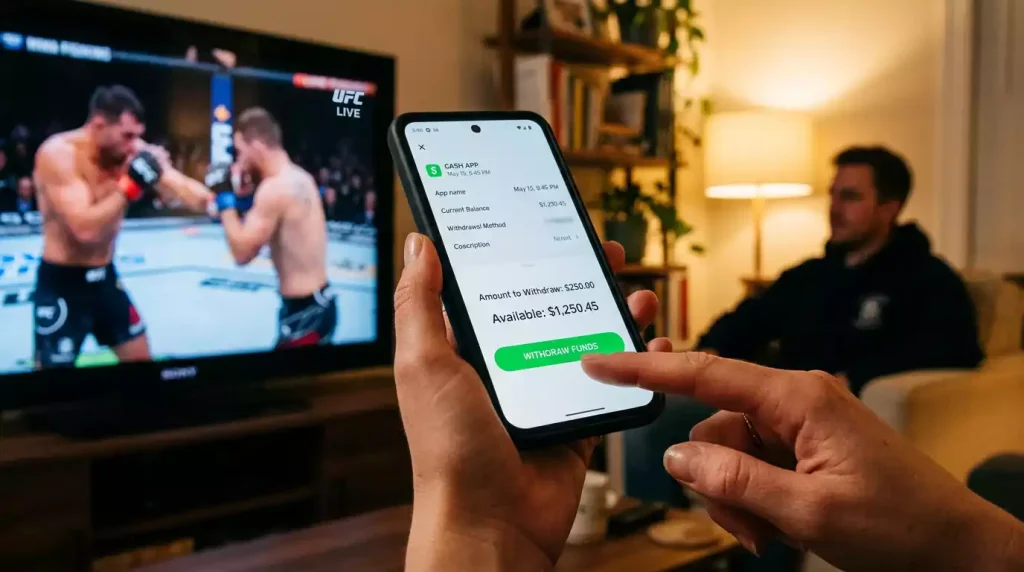
Cash out is a feature that lets you close a bet before the event finishes. If the fighter you backed is winning after two rounds and the bookmaker offers you an early payout, you can take it — locking in a smaller profit instead of risking a final-round upset. Partial cash out lets you settle part of the bet and leave the rest running. The cash-out price is always less than the full potential return, because the bookmaker is offering you certainty at a discount. Whether to use it depends on the specific situation, but knowing it exists gives you a tool most new bettors do not realise they have.
Settlement happens after the official result is confirmed. For MMA, this is typically quick — within minutes of the referee’s decision. The winning amount is credited to your account balance, ready to withdraw or re-stake. If a fight is ruled a no contest (which can happen due to accidental fouls or overturned results), your bet is usually voided and the stake returned. The settlement rules are in the operator’s terms and conditions, and they are worth reading at least once — particularly the sections on dead-heat rules and walkovers, which can apply when fights are cancelled after odds have been published.
Keep a record of every bet. It does not need to be sophisticated — a simple spreadsheet with date, fight, market, odds, stake, and result will do. After twenty or thirty bets, you will have enough data to see patterns: which types of bets you win most often, which weight classes you read well, and whether your overall approach is profitable or needs adjustment. I started tracking my bets in year one and I still reference those early records. The mistakes I made then are the foundations of the process I use now.
Building Your MMA Betting Knowledge
Placing a bet is the easy part. Getting better at it is where the real work begins, and the good news is that MMA rewards homework more than most sports.
UFC broadcasts reach over 900 million households across 170 countries, which means there is an enormous volume of publicly available fight footage, statistics, and analysis. The sport’s data infrastructure has matured rapidly. You can access per-fight statistics on significant strikes landed, takedown accuracy, submission attempts, and control time — all of which directly influence how fights are priced. The bettors who consistently do well are not the ones with secret information; they are the ones who process the publicly available information more carefully than the market does.
Start with the fighters on upcoming cards. Watch their recent bouts, not just highlight reels. Pay attention to how they respond under pressure, how they manage distance, and whether their output changes between round one and round three. Then check the statistics and see whether your visual impression aligns with the numbers. This cross-referencing builds a feel for fights that no algorithm can replicate.
The broader ecosystem matters too. Understanding how the 2025 UK gambling reforms affect your account — financial checks, stake limits for younger adults, the new statutory levy — gives you context that most casual bettors lack. Knowing that bookmaker margins vary by fight and by operator keeps you from overpaying. And recognising the integrity infrastructure behind the sport, including the monitoring systems that flag suspicious betting activity, reinforces why UKGC-licensed sites are the only defensible choice.
Betting on MMA is a skill, and like any skill, it improves with deliberate practice. The walkthrough in this guide gives you the process. What you build on top of it is up to you.
If you want to go deeper on the analytical side, I would suggest focusing next on understanding how different fight styles interact with betting markets. A wrestler facing a striker is not just a stylistic clash — it is a data point that affects method-of-victory odds, round totals, and whether the fight is likely to see the judges’ scorecards. That kind of structural thinking is what separates a bettor from a fan who happens to bet.
For more advanced strategies and comprehensive sportsbook reviews, visit the premier UK MMA betting guide.
The Questions Every New UFC Bettor Asks
Can I bet on UFC fights if I’m 18 in the UK?
Yes. The legal minimum age for gambling in the UK is 18. You will need to verify your age during the registration process with a valid ID such as a passport or driving licence. Note that the 2025 reforms introduced lower stake limits specifically for the 18-to-24 age group on certain products, so younger adults may encounter tighter restrictions on some types of bets.
What financial checks might a bookmaker run on my account?
Since February 2025, UK operators must conduct financial vulnerability assessments when your net deposits exceed £150 in a rolling 30-day period. This is not a credit check and does not affect your credit score. It is a light-touch review designed to identify signs of potential financial harm, using data sources such as public records rather than your personal bank statements.
How long does it take for a UFC bet to be settled?
Most UFC bets settle within minutes of the official result being announced. The referee’s decision triggers settlement for match-winner and method-of-victory markets. If a fight is ruled a no contest, bets are typically voided and your stake is returned. Accumulator bets that include multiple fights settle once all legs have concluded.
Do I need to verify my identity before placing a bet?
Yes. Under UK regulation, all licensed operators must verify your identity before allowing you to place a bet or withdraw funds. This is a legal requirement under Know Your Customer rules and involves providing photo ID. Some sites use automated verification that clears in minutes; others require manual review which can take a few hours.
This material was created by the OCTAEDGE team.
Related posts

Young People and MMA Gambling in the UK: Statistics, Risks, and Protections
UFC Betting Cash Out: How Early Settlement Works and When to Use It